
Table of Contents
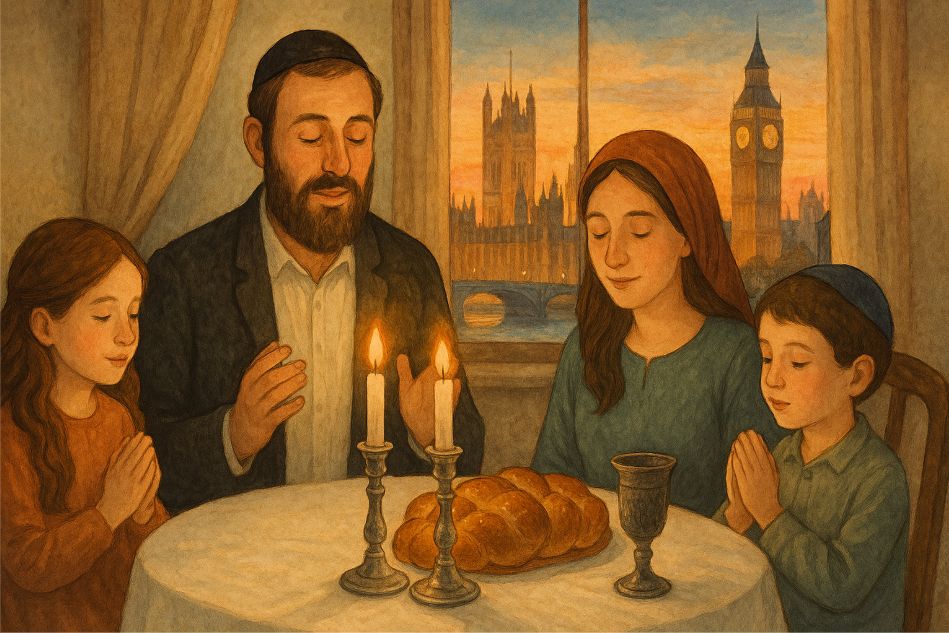
For Jews in London and across the globe, Shabbat is more than a weekly ritual. it’s a time to disconnect from the noise of modern life and reconnect with spirituality, family, and tradition.
Lasting from Friday evening to Saturday night, Shabbat commemorates the seventh day of creation, a divine rest after six days of work.
One of the most essential aspects of Shabbat is observing it at the correct times, marked by candle lighting before sunset and Havdalah after nightfall.
These precise moments not only honour tradition but are central to maintaining the sanctity of the day. In a city like London, where seasonal shifts affect sunset dramatically, relying on accurate times each week is vital.
This guide offers everything Londoners need to observe Shabbat times accurately from weekly candle lighting and Havdalah schedules to answers about Jewish customs and Sabbath history.
When is Shabbat?
Shabbat (or the Sabbath) begins at sunset on Friday evening and ends at nightfall on Saturday. The exact times vary weekly and by location due to changes in sunset and nightfall throughout the year.
In London, for example:
Start (Candle Lighting): Friday, typically 18 minutes before sunset
End (Havdalah): Saturday, after 3 stars appear in the sky usually 40–72 minutes after sunset
What time does Shabbat start and end in London?
In Jewish tradition, a new day begins at sunset, not at midnight. Therefore, Shabbat starts at sunset on Friday and ends at nightfall on Saturday.
In London, these times change significantly over the year. In the winter, Shabbat can begin as early as 3:40 PM, while in the summer, it can start closer to 9:00 PM.
The end time also shifts accordingly, always extending until three medium-sized stars are visible in the sky on Saturday evening often 40 to 72 minutes after sunset.
How to Know the Exact Times?
Reliable sources such as Chabad.org and MyZmanim.com calculate these times using halachic formulas and astronomical data specific to London’s coordinates.
What are the Shabbat candle lighting times in London this week?
Each week, Jewish families across London prepare for Shabbat by lighting candles 18 minutes before sunset. This moment, rich with spiritual meaning, welcomes the peace of Shabbat into the home and marks the beginning of sacred time.
Below is a real-time example table showing candle lighting and Havdalah times in London for the upcoming weeks of April 2025:
Accurate Weekly Candle Lighting & Havdalah Times in London
| Date (Friday) | Parashat | Candle Lighting (Fri) | Shabbat Ends / Havdalah (Sat) |
| 11 April 2025 | Metzora | 7:34 PM | 8:45 PM |
| 18 April 2025 | Acharei Mot | 7:45 PM | 8:58 PM |
| 25 April 2025 | Kedoshim | 7:55 PM | 9:10 PM |
| 2 May 2025 | Emor | 8:05 PM | 9:22 PM |
| 9 May 2025 | Behar | 8:15 PM | 9:35 PM |
Note: Times are based on central London location and rounded to the nearest minute. Always confirm with a trusted local source each week.
What is the 18-minute rule before Shabbat begins?
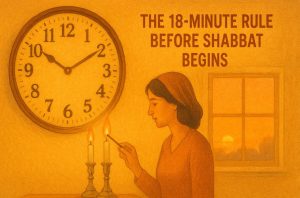
The 18-minute buffer before sunset is a halachic practice that allows observant Jews to complete all preparations before Shabbat officially begins.
Candle lighting must occur during this period because, once the sun sets, any form of “work,” including lighting a flame, is forbidden by Jewish law.
Historical and Spiritual Reasoning
This rule is derived from rabbinic interpretations of Torah commandments, designed to ensure that no commandment is accidentally violated.
It also promotes mindfulness, encouraging people to slow down and approach Shabbat with intention rather than last-minute stress.
Why does Shabbat last 25 hours instead of 24?
Although a regular day is 24 hours, Shabbat is extended to approximately 25 hours. This custom embodies the principle of tosefet Shabbat, which means “adding to the Sabbath.”
It symbolises a desire to extend holiness and avoid any doubt about when Shabbat truly begins or ends.
- Starting early and ending late helps prevent transgression due to clock inaccuracies or variable visibility of stars.
- This extension also provides a psychological and spiritual transition into and out of the sacred time of Shabbat.
Is Shabbat the same as the Sabbath?
Yes and no. While Shabbat and Sabbath refer to the same concept the seventh day of rest their observance and interpretation differ among religions.
Differences in Observance
In Judaism
- Observed from Friday sunset to Saturday nightfall
- Involves specific commandments like no work, candle lighting, prayer, and family meals
In Christianity
- Traditionally celebrated on Sunday
- Less structured, often involving church attendance and rest, but without halachic restrictions
Despite differences, both stem from the biblical commandment to “remember the Sabbath day and keep it holy.”
What time does the Sabbath start in the UK?
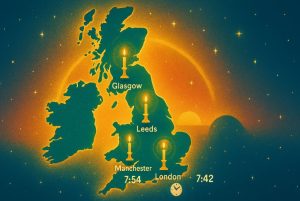
In the UK, the Sabbath (Shabbat) begins at sunset on Friday, which changes throughout the year. Because the UK uses a single time zone, the time difference across cities is minimal.
However, northern cities like Manchester or Leeds may experience sunset slightly later than London.
To be precise, candle lighting times are determined by:
- Latitude and longitude
- Elevation and weather conditions
- Jewish halachic guidelines
This is why postcode-based apps or websites are recommended.
What are five things observant Jews avoid doing on Shabbat?
Shabbat laws are based on 39 categories of forbidden work (melachot). Here are five major categories that affect daily living:
1. Using Electronics
Phones, TVs, computers, and even light switches are avoided.
2. Writing or Erasing
All forms of writing are considered creative work and are prohibited.
3. Cooking
Food must be fully prepared before Shabbat. Warming is allowed under certain conditions.
4. Driving or Travelling
Driving is forbidden as it involves ignition and exertion.
5. Carrying in Public
Carrying objects outside is restricted unless within an eruv—a symbolic boundary approved by rabbinic law.
These laws aim to create a peaceful atmosphere where spiritual pursuits take precedence.
What do Christians call the Shabbat or Sabbath?
Most Christians refer to the day as the Sabbath or Sunday, often considered “The Lord’s Day.” While the name Shabbat is rarely used, the essence of rest and worship carries over.
Historical Note, Early Christians, particularly Jewish converts, initially observed Saturday. However, over time, Sunday became the main day of worship, especially after Jesus’s resurrection, which occurred on a Sunday.
Did Jesus celebrate Shabbat during his lifetime?
Yes, Jesus of Nazareth observed Shabbat, as was customary for Jews in his time. The New Testament repeatedly shows him teaching in synagogues on the Sabbath and engaging in discussions about what is lawful to do on this holy day.
- Luke 4:16 – “As was his custom, he went to the synagogue on the Sabbath day.”
- His actions often challenged rigid interpretations, but never the sanctity of Shabbat itself.
Who changed the Sabbath from Saturday to Sunday and why?
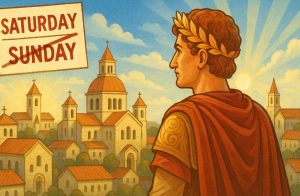
The shift from Saturday to Sunday worship was a historical evolution influenced by the Roman Empire and early Christian theologians.
- Emperor Constantine declared Sunday a public holiday in the year 321 CE.
- The Council of Laodicea (circa 364 CE) formally prohibited Christians from observing the Jewish Sabbath.
- Sunday was emphasised to celebrate the resurrection of Jesus.
This change created theological and practical separation from Jewish practices.
Where can Londoners find accurate Shabbat times each week?
To ensure precise observance, Londoners should use trusted sources for Shabbat times each week. Options include:
Chabad.org
Offers weekly zmanim, including candle lighting, Havdalah, and daily prayer times based on your postcode.
MyZmanim.com
A customisable tool for calculating halachic times according to multiple rabbinic opinions.
Local Synagogues
Many London synagogues distribute Shabbat timing sheets through email newsletters or WhatsApp groups.
Conclusion
Observing Shabbat according to accurate halachic times is more than a religious requirement. it’s a way of aligning oneself with a 3,000-year-old rhythm of sacred living.
In London’s fast-paced society, pausing each week to light candles, share meals, and disconnect from technology provides not just spiritual rejuvenation, but emotional and communal well-being.
By following reliable sources and understanding the traditions behind the times, Londoners can fully embrace the beauty and sanctity of Shabbat.
FAQs About Shabbat Times London
How are Shabbat times calculated in London?
They are based on astronomical data including sunset, twilight, and nightfall, adjusted for location using Jewish halachic formulas.
Is candle lighting always done by women?
Traditionally, women light candles, but men can and do light them when no woman is present.
Can you cook during Shabbat if it’s for religious reasons?
No, all food preparation must be done before Shabbat begins. Warmers like a blech or Shabbat hotplate may be used.
What is Havdalah and why is it important?
Havdalah is a ritual that marks the end of Shabbat. It involves blessings over wine, spices, and a candle to symbolise the separation between the holy and the mundane.
Are apps accurate for Shabbat times?
Yes, when synced with your GPS location and using reliable sources like MyZmanim or Chabad.org.
What is an eruv and how does it affect carrying on Shabbat?
An eruv is a symbolic boundary that allows carrying within public spaces according to Jewish law. Many areas in London have functioning eruvim.
Can children participate in Shabbat rituals?
Yes, children are encouraged to participate in candle lighting, Kiddush, meals, and singing Shabbat songs.