
Table of Contents
Ronnie Wood Net Worth & Quick Facts (2026)
By a correspondent who’s spent too many nights chasing rock legends through museum corridors and backstage corridors alike
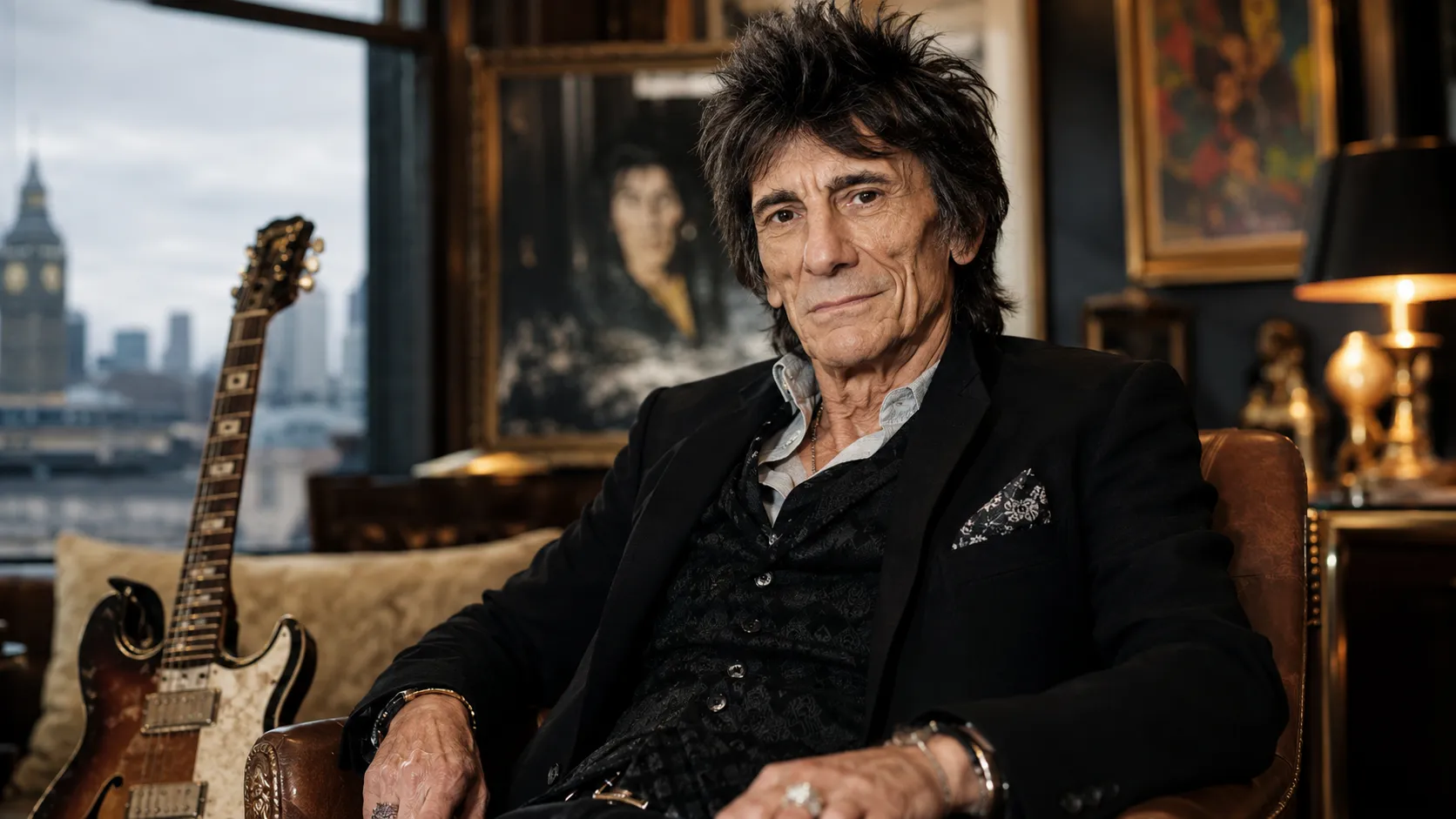
There’s a particular kind of chaos that erupts when Ronnie Wood walks into a room. Not the chaos of a man who demands attention he doesn’t need to but the chaos of a man who carries two entire universes inside him, both of them straining at the seams, both of them threatening to spill paint or guitar riffs onto everything and everyone within reach.
He is, in the most literal and extraordinary sense, an artist twice over: a founding father of British rhythm and blues who helped build the Rolling Stones into an eternal institution, and a formally trained visual artist whose canvases hang in galleries from London to Los Angeles.
That these two identities don’t merely coexist but actively feed each other is the great, underappreciated story of one of rock and roll’s most genuinely remarkable lives.
To understand Ronnie Wood, you have to resist the temptation to rank his gifts. The guitar did not win. The canvas did not lose. What happened instead is something far more interesting a lifelong conversation between two modes of expression, conducted simultaneously, sometimes in the same room, always at the same fever pitch.
What Came First the Guitar or the Brush?
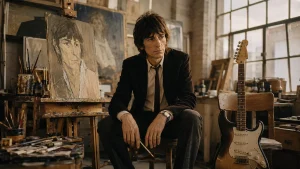 Ronald David Wood was born on June 1, 1947, in Hillingdon, Middlesex, into a family of canal boatmen who sang in close harmony on the water.
It was, by all accounts, a household steeped in folk melody and communal creativity an environment that primed young Ronnie for a life in which beauty was not optional but essential. But long before the guitar arrived to claim him, it was the image that spoke first.
This is not the romantic revisionism of a rock star burnishing his credentials. It is biographical fact. Wood studied at Ealing College of Art in the early 1960s the same institution that produced Pete Townshend of The Who and Freddie Mercury of Queen, making it arguably the most consequential art school in the history of British rock.
There, he encountered the classical traditions of portraiture and life drawing, absorbing techniques that would later surface in unexpected ways: in the fluidity of his guitar lines, in the compositional instincts he brought to the stage, in the way he has always seemed to be arranging rather than simply playing.
His formal training was rigorous. Wood studied under instructors who demanded mastery of the figure, who understood that great portraiture is not merely about likeness but about capturing the electricity of a human presence in a static medium.
Years later, when Wood began painting his fellow musicians Keith Richards, Mick Jagger, Chuck Berry the work bore the hallmarks of someone who had genuinely grappled with those questions. These were not celebrity vanity projects. They were character studies.
What Did The Faces Teach Him That No Art School Could?
By the late 1960s, the guitar had arrived in earnest, and Wood had fallen in with the Small Faces a band in the process of reinventing themselves as simply The Faces, following the departure of Steve Marriott and the addition of Rod Stewart.
What followed was one of the great underrated chapters in British rock history: a five-year run of shambolic magnificence, of boozy camaraderie, of a band that played as if the entire enterprise might fall apart at any moment, and sounded all the better for it.
This is where Wood’s dual sensibility first found its musical articulation. In The Faces, he developed the interplay-driven, conversational guitar style that would become his signature a style rooted less in individual virtuosity than in collective listening.
He and Keith Richards would later describe their approach to the Rolling Stones’ twin-guitar architecture in terms that echo the vocabulary of visual art: texture, space, negative space, balance.
That phrase “the ancient art of weaving” is not accidental poetry. It is the language of a man whose primary creative instinct is visual and spatial. A weaver does not ask which thread carries the pattern; the pattern lives in the relationship between threads. Wood’s guitar playing has always worked this way.
He is famously the “glue” of the Stones’ sound, the rhythm-lead hybrid who makes the space between Richards’ riffs breathable, who comps and accents and slides into the gaps with the instinct of someone who understands, at a cellular level, how composition works. You do not learn this in guitar lessons. You learn it in life drawing class, where the negative space is as important as the figure itself.
Why Did the Rolling Stones Need Ronnie Wood and Not Just Another Lead Guitarist?
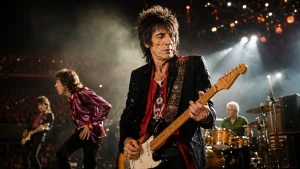 When Mick Taylor departed the Rolling Stones in December 1974, the band began an audition process that was, by all accounts, less of an audition and more of a courtship.
Wood had been in the Stones’ orbit for years he’d played on sessions, he’d run in the same circles, he’d absorbed the same influences. His 1974 solo album, I’ve Got My Own Album to Do, featured both Richards and Jagger, and the chemistry was so obvious it barely required comment.
He joined officially in 1975, just in time for the Tour of the Americas, and immediately the Stones became a different and arguably better band. Taylor had been a superlative lead guitarist, technically gifted in ways that made certain songs gleam.
Wood was something else: he was an ensemble player, a collaborator, a man who understood that the Stones’ greatness was not in any single moment of pyrotechnics but in the rolling, churning, relentless conversation between instruments.
It is, again, a painter’s instinct. A great portrait painter does not make every brushstroke loud. They know which marks to subordinate so that others can sing.
What he’s describing is not mere comfort with two tools it’s the recognition that both demand the same fundamental intelligence: knowing when to press and when to yield.
Does the Canvas Talk Back the Way an Audience Does?
Wood’s visual art which has been exhibited at the prestigious Castle Fine Art galleries across the UK, and has sold to collectors worldwide is impossible to separate from his musical life because it refuses to pretend that separation exists.
His subjects are almost exclusively musicians: Berry, Hendrix, Jagger, Richards, himself. His technique favors energy over finish, movement over stillness.
His line work is gestural, loose, recognizable in its confidence. These are drawings made by someone whose hands know how to find a note in real time, who understands that the first instinct is often the truest one.
The canvases, too, carry a musician’s sense of time. There is rhythm in the way Wood’s compositions are organized figures placed on the picture plane with the same intuitive spacing he brings to a guitar solo.
From the musician’s perspective, that’s the relief of working without bandmates, audience, and amplification. From the painter’s perspective, it’s the gentle tyranny of a medium that accepts everything and judges nothing, that allows revision without consequence.
This is, in a quietly profound way, the central difference between his two arts. Music is irreversible in performance every note either lands or doesn’t, and the moment moves on.
Painting permits reconsideration. Wood inhabits both truths simultaneously, which may explain the particular freedom of his guitar playing: he plays with the boldness of a man who knows he also has a canvas waiting for him at home.
Which Art Form Will History Remember Him For?
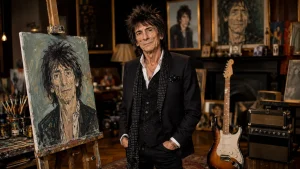 To watch Ronnie Wood paint is to watch a man play guitar without a guitar. To watch him play guitar is to watch a man paint without a brush.
The movements are the same: the slight tilt of the head, the narrowing of the eyes, the quality of attention that never quite looks like concentration because it has long since become instinct.
He has produced hundreds of paintings and drawings. He has played on dozens of albums, across six decades, with two of the most important bands in rock history. He has never, by any credible account, considered these activities separate. They are, to him, the same act performed in two different languages both of them fluent, both of them his native tongue.
What the rock world has sometimes failed to appreciate preferring instead the simpler narrative of the affable, hard-drinking fifth Stone is the intellectual and artistic coherence that underpins everything Wood does.
The weaving metaphor isn’t just a colorful way to describe guitar interplay. It’s a complete artistic philosophy, one that prioritizes relationship over hierarchy, texture over volume, the whole over any of its parts.
Ronnie Wood is, in the end, not a rock star who paints or a painter who rocks. He is something rarer: a man for whom creativity itself is the point, and who found, early enough to matter, two perfect vessels to pour it into.
The rest of us are just lucky we get to watch.
FAQs About Ronnie Wood The Artist, The Guitarist, The Legend
When did Ronnie Wood first start painting seriously?
Wood’s interest in visual artpredates his music career. He studied at Ealing College of Art in the early 1960s, receiving formal training in classical portraiture and life drawing before he had established himself as a professional musician.
Has Ronnie Wood exhibited his artwork professionally?
Yes. Wood has held numerous solo exhibitions, most notably through Castle Fine Art galleries across the United Kingdom. His work has been exhibited internationally and collected by both private buyers and institutions. His subjects are almost exclusively musicians, drawn from his personal life and rock history.
What is “the ancient art of weaving” that Wood refers to?
This is Wood’s description shared with Keith Richards of the twin-guitar interplay that defines the Rolling Stones’ sound. It refers to the way the two guitarists exchange roles between rhythm and lead so fluidly that even they cannot always identify, after the fact, who played what. It’s a musical philosophy rooted in listening and ensemble rather than individual showboating.
How did Wood’s art school training influence his guitar playing?
Wood’s formal training in composition, spatial relationships, and the balance between positive and negative space directly informs his approach to guitar particularly his understanding of when not to play, and how to support another musician’s melodic line. His role in both The Faces and the Rolling Stones has always been architectural as much as melodic.
What medium does Ronnie Wood primarily use in his visual art?
Wood works across multiple media, including oil, charcoal, ink, and lithography. His work is characteristically gestural and energetic, reflecting an artist more interested in capturing movement and personality than in achieving photographic precision. His line work is often compared to that of classically trained portraitists who have chosen expressive freedom over technical conservatism.
Does Wood consider himself more a musician or a visual artist?
By his own account, he considers the two inseparable. He has frequently stated that moving between guitar and paintbrush feels entirely natural, describing them as two expressions of the same underlying creative impulse rather than competing identities.
What is Wood’s classical art background specifically?
At Ealing College of Art, Wood studied under a curriculum rooted in the European tradition of figurative art life drawing, portraiture, and classical composition. The college was known in the 1960s for a faculty that balanced traditional technique with openness to emerging pop art and commercial design movements, giving students like Wood a rigorous foundation without stylistic rigidity.
How has Wood’s visual art career evolved since joining the Rolling Stones?
His output has grown substantially in both volume and ambition. What began as a personal practice sketching fellow musicians backstage, painting in hotel rooms during tours has evolved into a full parallel career, with dedicated studio time, gallery representation, and a body of work that stands independently of his musical reputation.